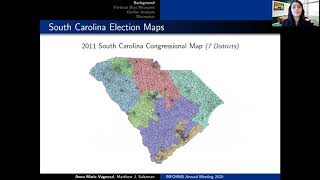
About to Boeing Colloquium Using Computational Sampling To Quantify Gerrymandering
Looking for the latest information on Boeing Colloquium Using Computational Sampling To Quantify Gerrymandering? We've compiled comprehensive data, records, and insights about Boeing Colloquium Using Computational Sampling To Quantify Gerrymandering.
Main Features
Explore the main sources for Boeing Colloquium Using Computational Sampling To Quantify Gerrymandering.
Recent Updates
Stay updated on Boeing Colloquium Using Computational Sampling To Quantify Gerrymandering's newest achievements.
Score-Based Generative Modeling without Diffusion: Langevin MCMC All the Way
On the computational tractability of a geographic clustering problem arising in redistricting
Boeing Colloquium: Randomized Algorithms for Linear Algebraic Computations
Boeing Colloquium: Mathematical Modeling from Kindergarten to Industry
Sampling from the Sherrington-Kirkpatrick model up to β<1/2
Monte Carlo Seminar| Guan-Horng Liu|Sampling with Schrödinger Bridge—An Adjoint-Matching Perspective
Statistical Techniques for Detecting Partisan Gerrymandering // INFORMS 2020
Boeing Colloquium: Computational Hypergraph Discovery, a framework for connecting the dots
Boeing Colloquium: Augmented Methods for Stokes-Darcy FSI Problems & HOC Schemes for Flux Type BCs
Boeing Colloquium: Developing high order, efficient, and stable time-evolution methods
Gathering data, measuring gerrymandering: the Districting Data REU
Deep Dive
Data is compiled from public records and verified media reports.
Last Updated: August 20, 2026
Final Thoughts
For 2026, Boeing Colloquium Using Computational Sampling To Quantify Gerrymandering remains one of the most talked-about information profiles. Check back for the latest updates.
Disclaimer: Disclaimer: All information is compiled from publicly available data, media reports, and analysis. Actual details may vary.